The school on Cliff Street
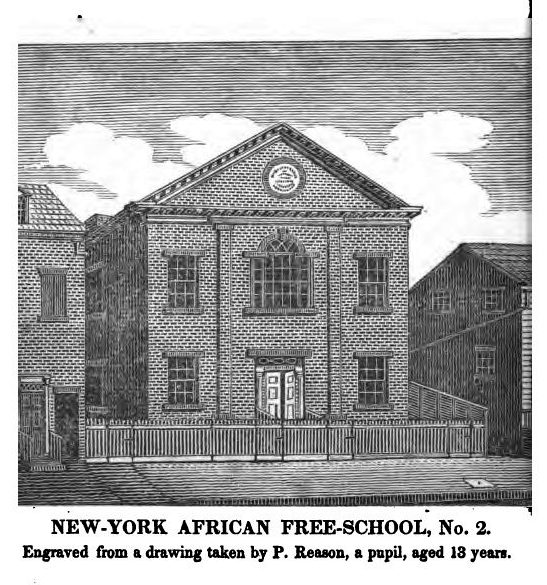
1787–1834In November 1787, the New-York Manumission Society opened a one-room school on Cliff Street with about forty students — Black children, most of them sons and daughters of enslaved and freed New Yorkers, in a city that would seat them in no other classroom. It was called the African Free School, and it was, by the standard of any age, a serious school. By the 1830s it had grown to seven buildings and more than a thousand students, and its roll of graduates reads like a founding register of Black American intellectual life: James McCune Smith, who left Cliff Street for the University of Glasgow and returned the first Black American to hold a medical degree; the orator Henry Highland Garnet; the scholar Alexander Crummell; Ira Aldridge, who became one of the celebrated Shakespeareans of Europe; Charles L. Reason, teaching mathematics in the school by fourteen and later among the first Black college professors in the country — and his brother Patrick, who at thirteen engraved the image of the schoolhouse that this school wears as its seal.
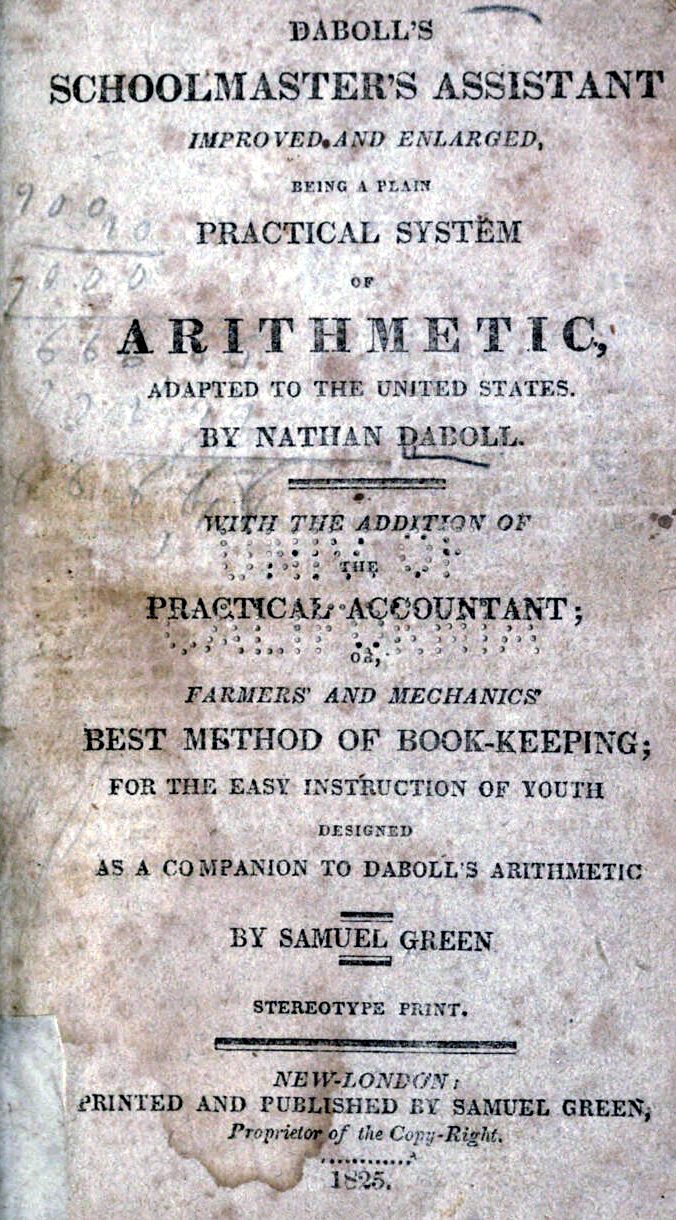
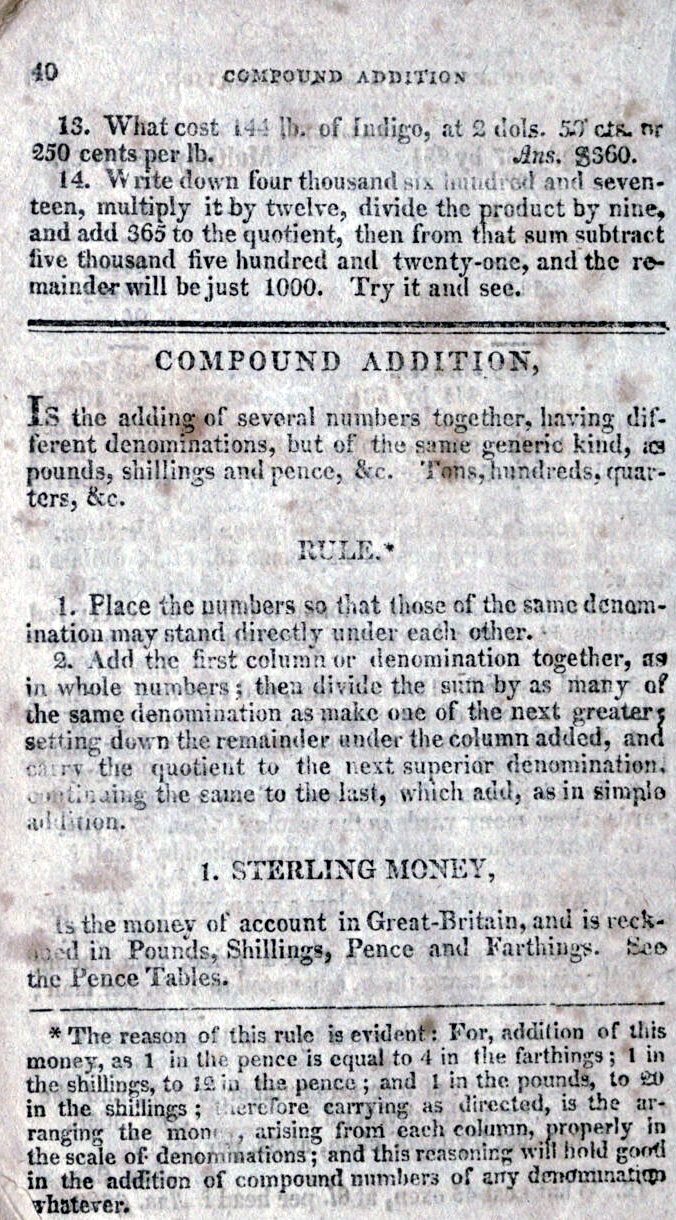
Look closely at how those children were taught arithmetic, because the method is the point. Schooling in that world ran on books built for mastery — arithmetics like Daboll’s Schoolmaster’s Assistant, organized rule by rule — and on the ciphering book: a blank volume into which each student copied every rule in their own hand, worked its problems in ink, and proved the answers before moving on. A ciphering book was a textbook the student wrote themselves. Mental arithmetic was recited aloud, from memory, daily. Under the school’s monitorial plan, older students who had proven their mastery drilled the younger ones — teaching as the final examination. And twice a year came public Examination Days, when children stood before visitors and answered until proficiency was not a claim but a performance.
“English grammar, composition, geography, astronomy, the use of the globes, map and linear drawing, are also pursued with interest and advantage by several of the male pupils.”
“The answers of both boys and girls to questions, in the important and useful branches of simple and compound Arithmetic, of Grammar, and of general and local Geography, especially that of our own country, were prompt and satisfactory.”
None of this is legend. The students’ actual pages survive, digitized — penmanship, composition, and worked mathematics in children’s own hands — in the New-York Historical Society’s African Free School collection, and the records of the public system that absorbed the free schools are preserved by the NYC Department of Records’ Municipal Archives. The city’s memory of how to teach is a matter of public record.
The argument America settled wrong
1893–1918A century after Cliff Street, American education faced the question that still governs your child’s school day: when the whole nation goes to school, does the whole nation get the strong version? In 1893 the country’s most influential answer was yes. The National Education Association’s Committee of Ten, chaired by Harvard’s president Charles W. Eliot, put it in one sentence — and its nine subject conferences endorsed it unanimously:
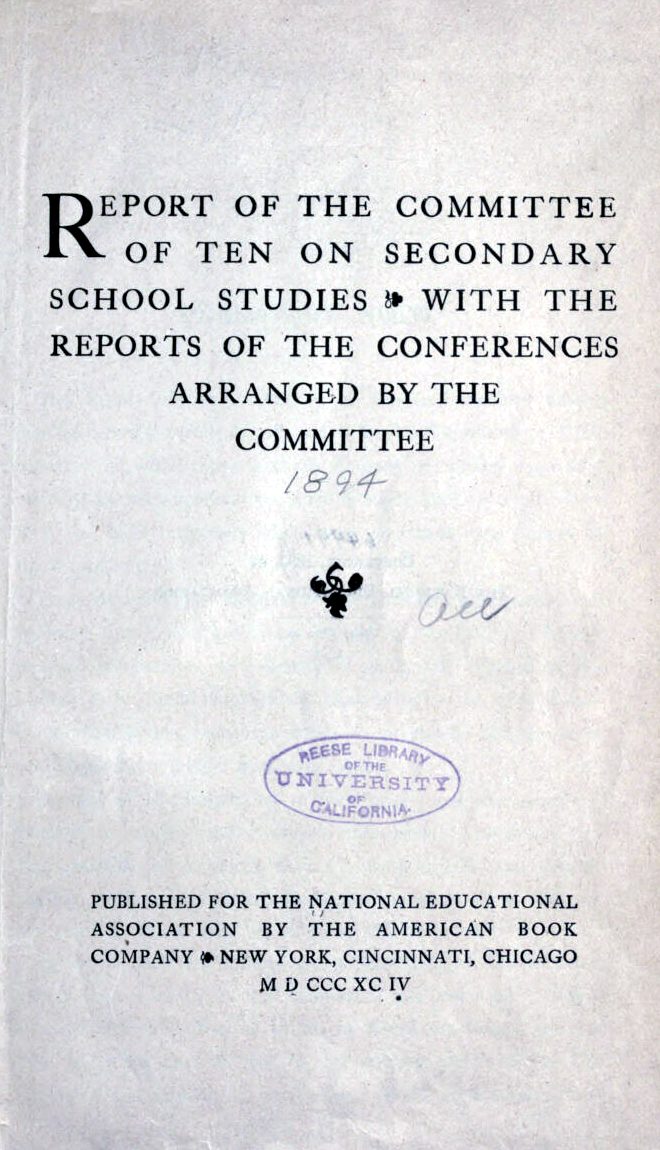
“…every subject which is taught at all in a secondary school should be taught in the same way and to the same extent to every pupil so long as he pursues it, no matter what the probable destination of the pupil may be.”
Within a generation that answer was overturned — not by evidence about how children learn, but by an argument about what the economy needed children to become. The new consensus was stated with unusual candor by the president of Princeton, addressing New York City’s own high school teachers in 1909:
“We want one class of persons to have a liberal education, and we want another class of persons, a very much larger class of necessity in every society, to forego the privileges of a liberal education and fit themselves to perform specific difficult manual tasks.”
By 1918, the NEA’s Cardinal Principleshad formally demoted academic mastery to one aim among seven — “command of fundamental processes,” filed alongside worthy home-membership and the worthy use of leisure. The 1920s added intelligence testing, which gave the sorting a scientific costume: children were measured, tracked, and routed — the majority toward courses built on the assumption that mastery was not for them. The public school’s quiet new job was not to produce educated people. It was to filter — to sort children toward their “probable destinations” rather than teach as if destination were the school’s to change. The bar moved from mastery to passing, and a 65 became a number a whole system could be built around.
The method went retail
1954–todayHere is the part parents feel but are rarely told. The technology of mastery — worked problems to proficiency, spaced review, recitation, the ciphering book’s discipline of writing knowledge into your own hand — never disappeared. It moved after 3 p.m., and it acquired a price.
In 1954, an Osaka mathematics teacher named Toru Kumon began writing daily worksheets for his own son, because school arithmetic was not building fluency and he knew what would: short, sequenced practice to mastery, every day, each sheet earned before the next. Kumon’s kitchen-table remedy is now a global enterprise serving millions of children — who do, after school and for a fee, more or less exactly what arithmetic class itself was on Cliff Street in 1820. Around it grew the rest of the shadow system: private tutors, test-prep houses, enrichment academies — a parallel school industry whose core product is the thing school stopped teaching: how to learn.
Inside the classroom, meanwhile, the textbook decayed. The book a student owned and worked through became the consumable packet; the packet became the photocopied worksheet; the worksheet became a slide deck read aloud. A child can now pass through thirteen years of school without working a single book that teaches a discipline whole — and without ever once being taught how to still know on Tuesday what was covered the Friday before. That burden did not vanish. It was transferred, unfunded, to parents — to whoever had the money, the hours, or the luck to buy the method back at retail.
Notice the inversion. In 1787, the strongest teaching of the age went to the city’s poorest children, for free. Today the method is sold after school by the hour — and the packet is what’s free.
The restoration
2026Everything about The Free School of New York follows from this history. Mental Arts — our mandatory first hour of every day — is the ciphering book and Examination Days rebuilt on modern cognitive science: theory of knowledge, real note-craft, trained memory, and the general method of becoming proficient, taught explicitly instead of left for families to purchase. Real textbooks again, chosen like you would choose for your own child. Oral defense of knowledge, the direct descendant of a child standing before visitors on Cliff Street. And a floor of an A — 90 or better, in every Regents subject — because the floor was mastery once before, in this city, for children this city refused to value.
It worked once. It is a matter of public record that it worked. We intend to make it ordinary again.
Sources Read the documents yourself
- Charles C. Andrews, The History of the New-York African Free-Schools (New York, 1830) — full text at the Internet Archive
- Examination Days: The New York African Free School Collection — digitized student work, New-York Historical Society
- Historical records of New York City’s school system — NYC Department of Records & Information Services, Municipal Archives
- National Education Association, Report of the Committee of Ten on Secondary School Studies (1893) — full text at the Internet Archive
- Woodrow Wilson, “The Meaning of a Liberal Education,” address to the New York City High School Teachers Association (January 1909)
- NEA Commission on the Reorganization of Secondary Education, Cardinal Principles of Secondary Education (1918)